Best Beaches in Colombia
Caribbean turquoise meets colonial charm — discover Colombia's finest beaches from Cartagena's coast to the remote island of San Andrés.
By BeachLoco Editorial
Colombia's Caribbean Coast Beaches
Colombia's relationship with its coastline has changed more dramatically than any country in South America. Two decades ago, the beaches were there but the tourists were not — decades of conflict had kept this stretch of Caribbean coast off most itineraries. Today, Cartagena is one of the most visited cities in Latin America, San Andrés fills flights from Bogotá every weekend, and Tayrona National Park has become one of the continent's most Instagrammed landscapes. The beaches, it turns out, were worth waiting for.
What makes Colombia's coast distinctive is its range within a relatively compact geography. You can swim in the warm, calm Caribbean of Cartagena's island archipelago, hike to jungle-framed bays in Tayrona, and fly to San Andrés for water clarity that matches the Maldives — all within a single week, all within one country's borders. The cost structure remains dramatically lower than comparable Caribbean destinations, and the cultural depth — colonial architecture, Afro-Caribbean music, world-class food — adds layers that pure beach destinations cannot match. For context on how Colombia compares to island destinations, see our South America vs Caribbean comparison.
Cartagena and the Rosario Islands
The boat pulls away from Cartagena's harbour at eight in the morning, passing the fortress walls of the old city as it heads southwest toward the Rosario Islands. The water changes colour gradually — harbour grey giving way to navy, then to the particular shade of Caribbean turquoise that exists only where shallow coral platforms meet open ocean. Within forty-five minutes, you are anchored off Isla Grande in water so clear that the shadow of the boat is visible on the sandy bottom three metres below.
The Rosario archipelago comprises 27 small coral islands, most of them privately owned or protected. Day-trip boats typically stop at two or three — Isla Grande for beach club infrastructure and snorkelling, smaller islands like Isla del Pirata or Cholón for swimming in natural pools formed between mangrove roots. The water temperature hovers around 28°C year-round, and the snorkelling reveals brain coral, sea fans, and clouds of sergeant major fish in visibility that extends fifteen metres on good days.
Back on the mainland, Playa Blanca on the Barú peninsula has become Colombia's most famous beach — a wide strip of white sand lapped by calm turquoise water, lined with thatched-roof restaurants selling fried fish and cold beer. It has grown more commercialised in recent years (beach chair vendors can be persistent), but the fundamental appeal remains: Caribbean-quality water and sand at a fraction of what similar beaches cost in Aruba or the Bahamas. For the best local restaurants and experiences in Cartagena, check the Local Picks.
Best time: December through April for dry season and calm seas. March offers the best weather-to-value ratio. Insider tip: Skip the large-group boat tours and hire a private lancherito from the Bodeguita dock area. Negotiate the price before departure (expect to pay more than a group tour but far less than a charter), specify which islands you want to visit, and bring your own snorkelling gear — rental equipment on the islands is overpriced and often poor quality. For budget planning, see our budget destinations guide.
San Andrés — Colombia's Caribbean Island
The flight from Bogotá to San Andrés takes under two hours, but the cultural distance is immense. This is not mainland Colombia — it is a Raizal island, home to an Afro-Caribbean, English-Creole-speaking community whose cultural roots are closer to Jamaica and Providence than to Cartagena. The food is different (rondón — a rich coconut seafood stew — is the island dish), the music is different (reggae and calypso rather than cumbia), and the pace is different (nothing happens quickly on San Andrés, and no one minds).
The water, though, is the main attraction. San Andrés sits on a shallow coral platform that creates the legendary 'Sea of Seven Colours' — a shifting mosaic of blues, greens, and turquoises visible from the air on approach and from the shore at almost every beach. Spratt Bight, the main town beach, offers a wide strip of white sand and calm water with the colour palette of a retouched postcard (it is not retouched). Johnny Cay, a tiny island ten minutes by boat, is essentially a sandbar surrounded by reef — the snorkelling here, in chest-deep water over coral gardens, is the island's best accessible experience.
Rocky Cay, reachable by wading at low tide (the water barely reaches your thighs for 400 metres), provides the kind of castaway moment that larger Caribbean islands have developed out of existence. You wade across a warm, sandy-bottomed channel, arrive at a small rocky island with a few palm trees and no facilities, snorkel around its edges, and wade back. It costs nothing. It takes an hour. It is, genuinely, one of the best low-key beach experiences in the Caribbean.
Best time: January through April for clearest visibility. Insider tip: Rent a golf cart and drive the 30-minute ring road around the island — the west-coast beaches (San Luis, Sound Bay) are where Raizal families go on weekends, and the atmosphere is entirely different from the tourist-facing east coast. Stop at a beachside 'ranchón' in San Luis for rondón served by the families who invented it. For more detail on how San Andrés compares with other Caribbean alternatives, see our comparison guide.
Tayrona National Park
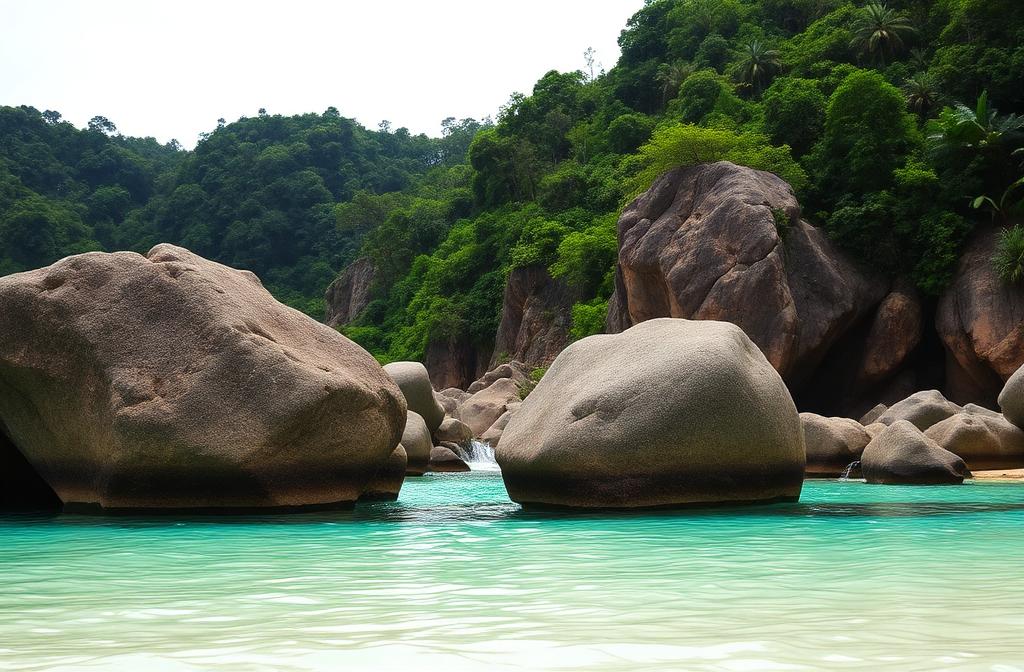
Tayrona is where the Sierra Nevada de Santa Marta — the world's highest coastal mountain range — meets the Caribbean Sea, and the collision is dramatic. Enormous granite boulders frame bays of turquoise water. Tropical forest grows to the tideline. The beaches are accessed by trails that wind through jungle thick enough to hear howler monkeys in the canopy above. This is not a beach resort. This is a national park that happens to contain some of South America's most extraordinary beaches.
Cabo San Juan del Guía is the park's star attraction — a horseshoe bay divided by a rocky promontory that you can climb to reach a hammock platform with 360-degree views of jungle and sea. The trek from the park entrance takes about two hours through forest, passing Arrecifes (dramatic but dangerous for swimming due to currents) and La Piscina (calmer, swimmable, and named for its pool-like clarity). Cabo San Juan itself offers calm water on one side for swimming and more exposed conditions on the other for watching waves crash against boulders.
The park limits daily visitors and closes periodically for ecological recovery (typically for two weeks in February and two weeks in June — check before planning). Camping is available at Cabo San Juan and several other points within the park, and the experience of falling asleep to jungle sounds with the Caribbean lapping the shore a hundred metres away is one of Colombia's great travel moments.
Best time: December through March for the driest conditions. The park can close during heavy rains. Insider tip: Enter from the Calabazo entrance (eastern side) rather than the main Zaino entrance — the trail is less crowded and offers better forest walking. Bring reef-safe sunscreen and enough water for the full hike. For more remote beach experiences, explore our hidden beaches guide.
Palomino and the Northern Coast
Palomino sits at the base of the Sierra Nevada, where a river meets the Caribbean in a long, wide beach of golden sand. It is quieter than Cartagena, less developed than Santa Marta, and increasingly popular with travellers who want a Colombian beach experience without the city infrastructure. The main activity is river tubing — floating down the Palomino River on an inflated inner tube through jungle, emerging at the beach where the river meets the sea. It takes about 90 minutes, costs almost nothing, and is exactly as relaxing as it sounds.
The beach itself is large, often windy, and not always swimmable (currents can be strong), but the setting — mountains behind, jungle to the sides, wide open Caribbean in front — is one of the most dramatic on Colombia's coast. Boutique hostels and eco-lodges have appeared along the river in recent years, and the food scene (fresh seafood, Venezuelan arepas from the cross-border community) is better than a town this size has any right to offer.
Best time: December through April. Insider tip: Combine Palomino with a visit to the Lost City (Ciudad Perdida) — the four-to-five-day trek through the Sierra Nevada starts nearby and is one of South America's great adventure experiences. Return to Palomino for recovery beach time afterward.
Planning Your Colombia Beach Trip
Colombia's coast rewards a two-week itinerary: three to four days in Cartagena (city exploration plus island day trips), three days in Tayrona or Palomino, and three to four days on San Andrés. Internal flights are affordable — VivaColombia and Wingo offer budget fares between the main coastal cities.
For the complete South America beach picture, explore our pillar guide. For budget strategies, read our cheapest destinations guide. And for the full destination explorer, visit our South America hub.